Agentic commerce, part two: the cheapest thing in retail is now the most valuable
Whether you exist in an AI agent's reasoning window comes down to one thing: product data clean enough for a machine to trust.

Yesterday, I wrote that the funnel didn't die, it got bypassed. The agent is the new shop window, the protocol is the new shelf, and a handful of US companies are quietly building the rails.
Part I: Agentic commerce: the funnel didn't die, it got bypassed.
"But what does the corner shop actually do about this?" Fair question. And the answer is more interesting than I expected, because the thing that determines whether you exist in an agent's reasoning window is not your marketing budget, your retail media spend, or your brand equity. It's whether your product data is clean enough for a machine to parse with confidence.
That's it. That's the whole filter.
Which means the most expensive things in enterprise retail (the brand campaigns, the agency retainers, the retail media budgets) are now worth less than the cheapest thing in the building: a disciplined product data spreadsheet. And the operators best positioned to win that fight are not the ones you'd expect.
Schema is the new SEO
When I say "schema" I don't just mean Schema.org JSON-LD, though that's part of it. I mean the broader discipline of structured, machine-readable data: product titles that say what they are, attributes that match a controlled vocabulary, inventory counts that are actually accurate, shipping ETAs an agent can act on without phoning you. The web's first era rewarded human-readable content. The next era rewards machine-readable content. Same words, completely different audience.
The old SEO playbook (keyword density, backlinks, content moats) was built for a world where Google sent humans to your site. That world is no longer guaranteed. AI Overviews answer the query without sending a click. Agents skip the page entirely and read the structured data underneath. If your product information isn't there, in a form a machine can confidently retrieve and cite, you don't exist in the conversation.
This is a re-skilling event for an entire industry. SEO teams that spent a decade optimising H1 tags and meta descriptions now need to be fluent in product feeds, attribute taxonomies, and inventory APIs. The work has moved three layers down the stack, into the bit that nobody at the marketing offsite ever wants to talk about.
The protocols make schema mandatory, not optional
A quick definition for anyone not in the weeds. ACP is OpenAI's Agentic Commerce Protocol, co-built with Stripe. UCP is Google's Universal Commerce Protocol, launched at NRF in January. AP2 is the Agent Payments Protocol, the rails layer underneath them. Different sponsors, different governance, broadly the same job: define how an autonomous agent finds a product, verifies it's available, and pays for it without a human touching a checkout page.
None of these protocols prefer structured data. They require it. To be eligible for transaction routing through any of them, your product catalogue has to be syndicated in a machine-parseable form, your inventory has to be queryable in real time, and your shipping commitments have to be expressed in a way the agent can rely on. A jpeg of a product on a Wix page is not a product. A blog post mentioning that you sell something is not a listing.
The big merchants on Shopify, Amazon, Etsy, and eBay already meet the bar because the platforms did the heavy lifting for them. Everyone else has to do it themselves or get help.
That sounds like bad news for the small operator. It mostly isn't, and the reason mostly isn't is the bit nobody is talking about.

"the cheapest thing... is now the most valuable" | Mike Fowler
Three cohorts, three paths
The "small business" conversation in agentic commerce keeps collapsing every SMB into one bucket, which is unhelpful because they don't have the same problem.
The e-commerce SMB. Shopify, WooCommerce, BigCommerce. A few hundred to a few thousand SKUs. The owner is also the marketer, the buyer, and the customer service team. For this cohort, schema is something you do. The work is unglamorous and mostly known: GTINs on every variant, consistent colour vocabulary (pick one of "charcoal," "dark grey," or "graphite" and stick to it across the whole catalogue), shipping ETAs that match what your warehouse actually does, and real inventory rather than yesterday's batch. An agent that sees a 2-day delivery promise on the PDP and a 5-day reality at checkout doesn't just lose the sale, it learns not to trust the merchant. None of that requires a developer. Most of it can be done in a Shopify admin in a weekend. And the operators who do it will be visible to agents in a way that mid-market brands with eight-year-old Magento installs and three competing product feeds simply won't be. Don't forget to modfiy your robots.txt and llms hints.
The local services and physical SMB. Cafes, hairdressers, mechanics, accountants, florists, panel beaters, regional B&Bs. No product catalogue in the e-commerce sense. Maybe a never-touched Wix page from 2016. Maybe just a Facebook page. For this cohort, here is the genuinely good news that almost nobody is telling them: Google has already done the schema work on your behalf.
Google Business Profile (GBP) is, quietly, the largest structured local commerce dataset in the world. Hours, location, services, attributes ("outdoor seating," "good for kids," "wheelchair accessible"), booking links, reviews, photos with OCR'd menus, inferred price ranges. The cafe owner whose entire digital footprint is a jpeg of a menu the nephew photographed in 2019 has still had their dishes, prices, and dietary tags extracted into a structured dataset. Gemini will recommend that cafe when an agent asks "find me somewhere for a long lunch in Fitzroy that takes bookings." The proprietor did nothing. The platform did it for them.
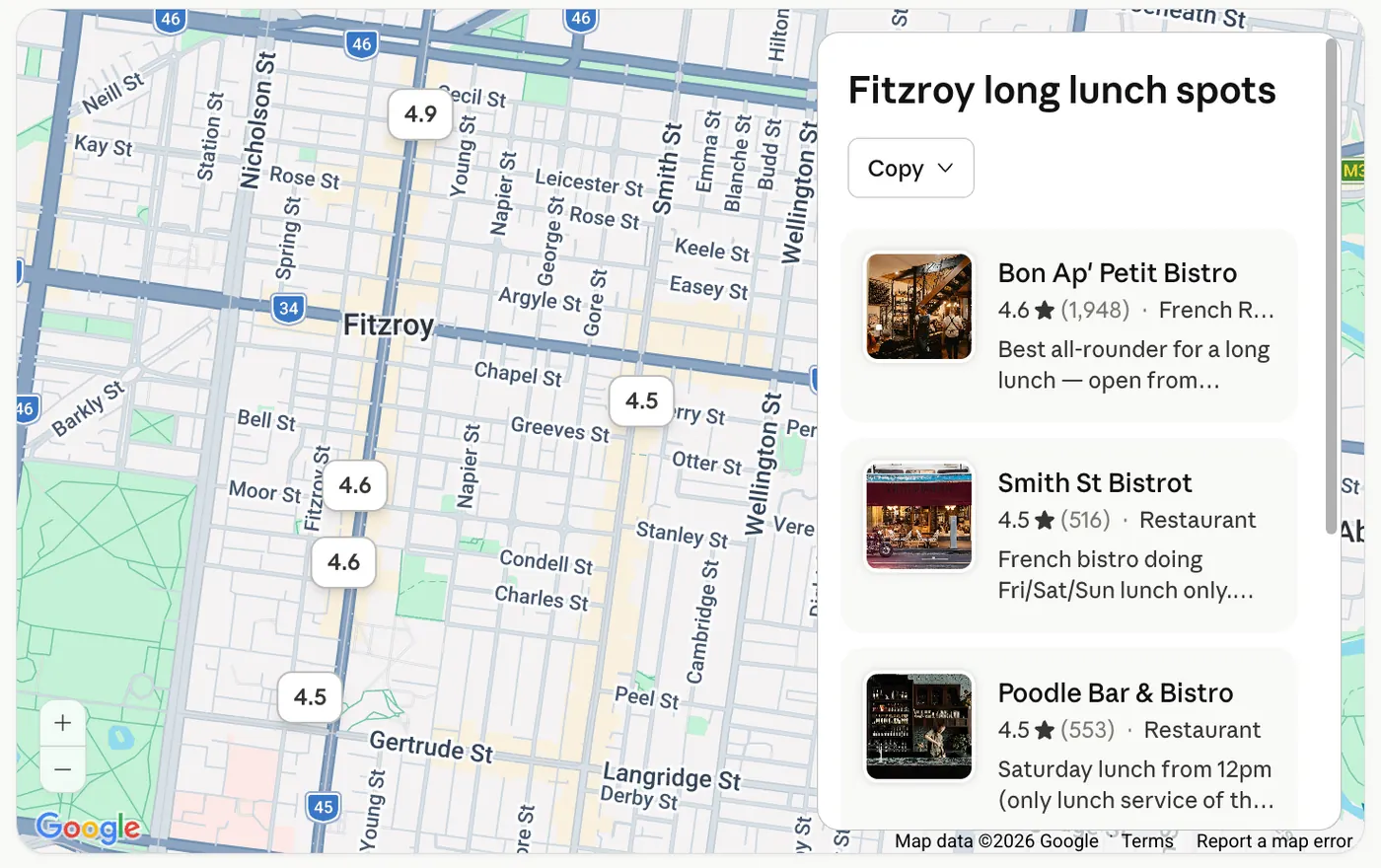
"find me somewhere for a long lunch in Fitzroy that takes bookings." | Mike Fowler
Gemini and Claude fully utilised the Places API:
I delivered these results specifically because of the structured data available within Google Business Profiles (GBP). As an AI, I don't "browse" the web like a human clicking links; I parse datasets to find matches for your specific constraints ("long lunch," "Fitzroy," "takes bookings"). Here is exactly why the Google Business Profile made those restaurants visible to me:
This is the most under-appreciated story in the entire agentic commerce conversation. The local SMB has a head start they don't know they have.
The hybrid. Independent bookshops with online stores. Boutiques with click-and-collect. Bakeries that do wholesale. Brewers selling DTC and through bottle shops. This cohort has to win in both surfaces with two different data disciplines, and they are the ones with the most to gain by getting it right early, because they can be discovered in the global agent surface ("find me a signed copy of...") and the local one ("...within 20 minutes of me") simultaneously. Almost nobody is positioned to do both well right now. The first movers will own categories.
So upgrade your GBP... don't wait. Get more content in there ASAP.
Why the lazy enterprise is more vulnerable than it looks
Here is the part of this I find genuinely interesting.
A national chain with $500 million in revenue and a marketing department of ten to twnety people very often has worse structured data than the single-location cafe down the road. The chain's GBP is managed centrally by an agency that hasn't updated the Christmas trading hours in three years. The product catalogue is spread across an ageing PIM, three competing data sources, and a marketing copy field where the size chart is supposed to live. Four different "colour" attributes that don't agree. Inventory feed batched overnight, so an agent asking "is this in stock now" gets an answer from yesterday.
The cafe owner, meanwhile, fixed his trading hours last Tuesday from his phone, in thirty seconds, while the lunch rush was setting up.
Agents reading those two profiles cannot tell which one has the bigger marketing budget. They can only tell which one has accurate, current, machine-readable data. In a world where the agent is the buyer, that's the only signal that matters at the moment of decision.
This is the part the enterprise can't easily fix, because the fix is unglamorous, lives three layers down in someone's operations team, and doesn't show up on a quarterly board deck. Cleaning a 50,000-SKU catalogue and rebuilding the attribute taxonomy is not a campaign. It's not a launch. It's eighteen months of careful, boring, expensive work that no agency wants to sell and no CMO wants to champion. So it doesn't get done. And the small operator who can fix their data in a weekend keeps eating their lunch in the agent's reasoning window, transaction by transaction. Albeit, AI can help here.
The Google angle nobody is talking about
Maps was never just navigation. It was commerce infrastructure.
Google spent fifteen years turning the physical world into structured commerce data: photographing menus, extracting hours, soliciting reviews, OCR'ing laminated price lists, paying an army of Local Guides to verify the lot. Most of us assumed we were getting better directions. We were also building the world's largest structured local commerce dataset, on Google's balance sheet, for free.
OpenAI cannot retroactively photograph every menu in Australia. Amazon cannot infer trading hours for every panel beater in Geelong. Anthropic cannot OCR the price list in every suburban hairdresser. That dataset took a decade and a half to build and it is sitting inside Google Maps right now. Facebook too.
Apple has Business Connect and Apple Maps and is clearly trying to build a competing surface, but the gap is real and probably not closable inside this cycle. The local agentic commerce layer might end up being the one corner of this whole shift that doesn't get re-intermediated to a US protocol layer. It is already intermediated, and Google already owns it. Whether that's good or bad depends on where you sit. For SMBs, it's mostly good: the platform has done their structured-data homework and isn't charging them to be in the dataset. For everyone else, it's another reminder that the gatekeeper layer in this new era is going to be smaller and more concentrated than the open web ever was.
Schema plus brand: the survival stack
Schema gets you found. Brand gets you asked for by name. Neither is sufficient on its own.
A perfectly structured product feed for a brand nobody has heard of will still lose to a less-perfect feed for a brand the customer typed into the prompt directly. And the most loved brand in the world can't be sold by an agent that can't parse what it sells, where it ships from, and whether it's in stock. The SMB survival stack in the agentic era is both: clean data and earned mindshare. The good news is that both are, in different ways, more accessible to a small operator than the equivalents were in the last era. You don't need a media plan to build mindshare anymore, creators, community, and authentic content do that. You don't need a developer to build clean data, Shopify and GBP do most of it for you.
The bad news is that the operators who realise this and act on it will pull away from the ones who don't, fast. The gap between a small business with disciplined data and a small business without it is about to become much larger than it has ever been.
What to do, by cohort
If you sell physical products online, get your product data clean. Attribute by attribute. GTIN by GTIN. Spend the weekend on it. Revisit your robots.txt.
If you run a local services or hospitality business, claim your Google Business Profile, fix the inferred data, add what Google guessed wrong about, and answer the questions in the Q&A section. That's it. That's the work. Do it regularly and keep it fresh.
If you run a hybrid, do both, and recognise that you are sitting on the most defensible position in the entire SMB landscape if you move now.
And if you run an enterprise retailer reading this thinking "we're fine" - you almost certainly aren't. Pull a sample of fifty SKUs from your live feed tonight and try to parse them as a machine would. The result will be educational.
For twenty years the internet rewarded whoever could buy the most attention. The next era rewards whoever can be understood most clearly by a machine.
That is a sentence I never expected to write. But it's where we are. And for the first time in two decades, the small operator has a structural advantage they didn't have to pay for.
Use it.