Online Marketplaces in Australia: 2026
In 2022 Australia was the land of the online marketplace. Four years on, the abundance story has met a culling. The state of play, and why.

Four years ago I wrote that marketplace roll out was growing so fast it was hard to keep track of. The list has not stopped moving since. It has just started moving the other way.
In 2022 I called Australia the land of the online marketplace and ran a list of around fifty of them, B2B and B2C, product and service. The pitch was abundance. New marketplaces were launching faster than anyone could count, national retailers were standing them up as range extension, and the whole category felt like it only pointed one direction.
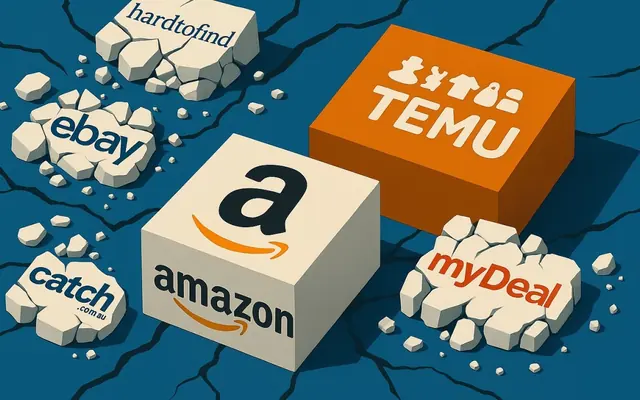
No solutions and no advice in the recap that follows, just the state of play, then a separate section at the end where I get into the why. The short version is that the abundance story of 2022 has met a culling, and the timing of that culling lines up almost exactly with the arrival of Temu and the scale up of Shein and Amazon.
Two of the most recognised standalone marketplaces in the country shut in the last fourteen months. A third, the one I opened the 2022 article with, switched off its Australian operation. And the email that prompted this update landed in my own inbox three weeks ago.

Catch.com.au | Ceased trading as of 30 April 2025
Catch is gone. Wesfarmers confirmed in January 2025 that Catch would cease trading as a standalone business, and the site stopped selling on 30 April 2025. The fulfilment centres at Truganina and Moorebank were handed to Kmart Group. Founded in 2006 as Catch of the Day, bought by Wesfarmers in 2019 for $230 million, the total cost of the wind down has been reported north of $400 million. Wesfarmers named the cause directly in its own statement: a recent increase in competitive intensity in the Australian e-commerce sector.
MyDeal followed it out the door. Woolworths announced on 27 June 2025 that it would close the MyDeal customer website by 30 September 2025, folding the technology and seller relationships back into BIG W Market and Everyday Market. Woolworths had bought 80 per cent of MyDeal in 2022 in a deal that valued it around $271 million. The closure carried cash costs of $90 to $100 million plus a roughly $45 million impairment. Same stated reason as Catch: an intensely competitive environment, and the superior economics of marketplaces built into a retail brand rather than run on their own.
BikeExchange, the company I led the 2022 article with, paused its Australian operations effective 30 June 2025. It had already delisted from the ASX in May 2024. The business still trades in North America and Europe, where it says the scale is, but the Australian marketplace that started it all, founded in Melbourne in 2007 by Sam Salter and Jason Wyatt, is dark at home. Its homepage now reads, simply, that it is taking a break.
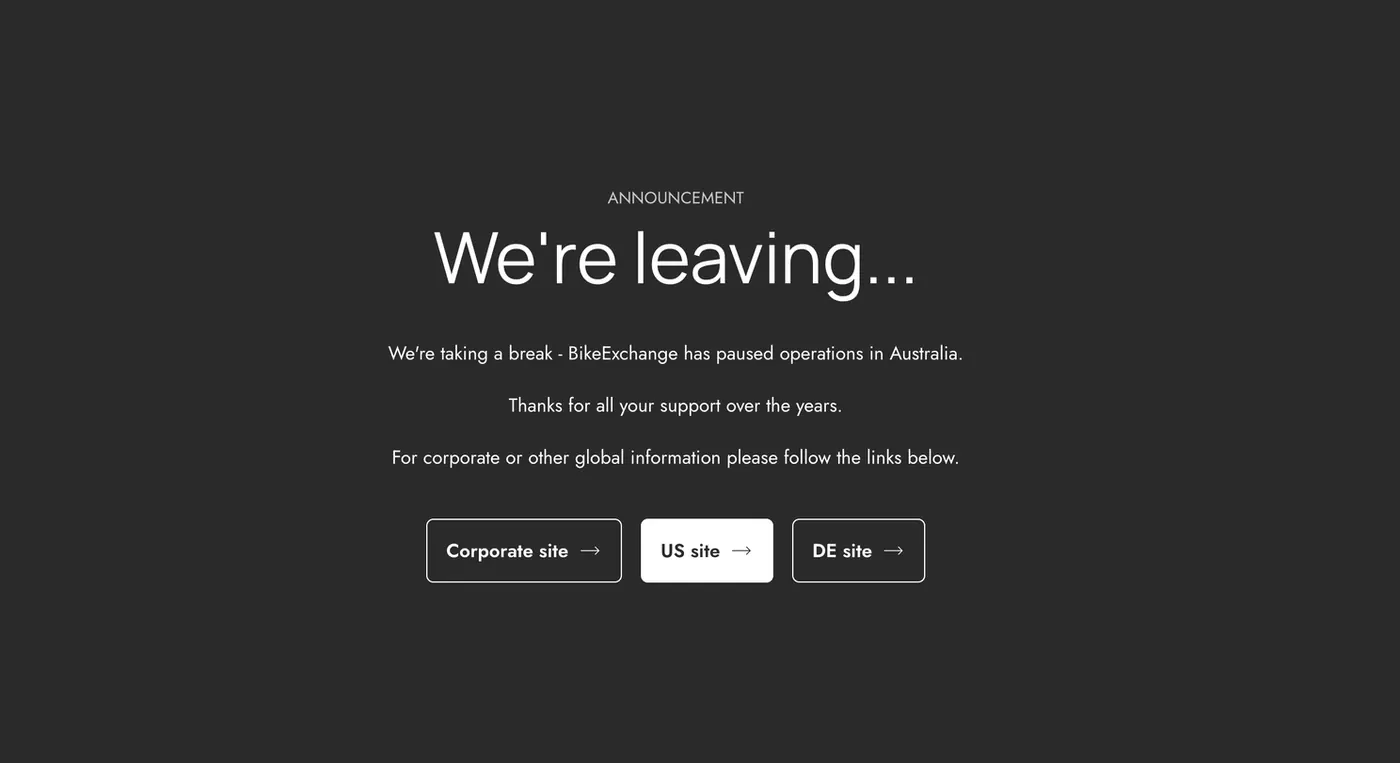
BikeExchange | Paused in Australia
Endeavour Marketplace is the most recent. On 3 June 2026 Endeavour Group emailed its partners to say it had made the decision to close Endeavour Marketplace, the third party drinks marketplace spanning Dan Murphy's and BWS, as part of a strategic review ahead of FY27. The final trading date is 1 September 2026. New product publishing is already switched off. The pivot offered to sellers is to apply for in-store ranging through the Endeavour Partner Portal instead, which is to say: stop being a marketplace seller, become a wholesale supplier.
The marketplace that started my 2022 list and the marketplace that emailed my own inbox in 2026 both switched off the same way. Not bankruptcy. A strategic decision that the standalone channel was not worth running.
Beyond the marketplaces themselves, a large block of my 2022 list disappeared inside a single corporate collapse. Mosaic Brands entered voluntary administration in October 2024 and went into liquidation in July 2025. With it went the entire stable I had listed as marketplace and pure-play names: Noni B, Rivers, Katies, Rockmans, Millers, Autograph, Crossroads, W. Lane and Beme. At its peak Mosaic had more than 4 million online members and roughly 800 stores. Final debts were reported at over $318 million. In August 2025 the Federal Court ordered the liquidated company to pay $25 million in penalties for failing to deliver hundreds of thousands of online orders on time.

Mosaic Brands | Closed and Liquidated
EziBuy, also on the 2022 list and also a Mosaic asset by then, went into administration in April 2023 and liquidation in July 2023.
So nine brand names from the original guide trace back to one failure, and a tenth to its parent. That is before counting Catch, MyDeal and BikeExchange. A meaningful slice of the 2022 list is now a historical document.
Plenty of players are still alive, but the survivors cluster. Here is the ledger as it stands at 26 June 2026.
Closed:
- Catch: Stopped trading 30 April 2025. Fulfilment absorbed into Kmart Group.
- MyDeal: Closed 30 September 2025. Tech and sellers folded into Everyday Market and BIG W Market.
- Endeavour Marketplace (Dan Murphy's / BWS): Final trading date 1 September 2026. Sellers redirected to in-store ranging.
- Mosaic Brands: Noni B, Rivers, Katies, Rockmans, Millers, Autograph, Crossroads, W. Lane, Beme. Liquidated 2024 to 2025.
- EziBuy: Administration April 2023, liquidation July 2023.
- BikeExchange: Australian operations paused 30 June 2025. Still trading in North America and Europe.
Open:
- Amazon Australia: Around 8.8 million Australian shoppers in the year to mid-2025, up roughly 900,000 year on year. Launched Amazon Haul, its sub-$25 channel, to meet Temu head on.
- Temu and Shein: Roughly 5 million and 2.9 million Australian shoppers respectively in 2025. Combined sales near $12 billion with Amazon. The disruptors named by every retailer that closed.
- Everyday Market and BIG W Market (Woolworths): The integrated marketplaces MyDeal was folded into. Part of Woolworths MarketPlus.
- The Iconic: Integrated marketplace inside an established retail brand.
- eBay Australia: Still large, but losing shoppers year on year per Roy Morgan. Launched eBay Live for real-time selling in 2025.
- Kogan: Open and returned to profit, but in the cohort losing shoppers to the ultra-cheap platforms.
Temple & Webster, Bunnings, Myer and the vertical and retailer-led players. Broadly still trading. The standalone horizontal model is the one under threat, not the category.
Out of that group, Bunnings, is the only one reporting strong growth. Largely led by their brand position. They have some of the strictest marketplace listing rules and only list products that supplement their retail 1P offering vs. compete.
The platform layer that powered the 2022 boom is still here. Marketplacer and Mirakl continue to run marketplace infrastructure for Australian brands. That part of my original thesis held: the software that lets a retailer stand up a marketplace is a real and durable business. What changed is who should be standing one up, and on what model.
The category did not shrink. It concentrated. The Australia Post eCommerce Report 2026 puts total online spend at a record $82.6 billion in 2025, up 14 per cent, now 24 per cent of all retail. Pure online marketplaces alone, the report's definition explicitly being platforms like Amazon and Temu and explicitly excluding retailer-owned marketplaces like BIG W Market, took $18.9 billion of that, up 13 per cent, and accounted for 23 per cent of total online spending. Most of the growth is made up by the big 3: Amazon, Temu and Shein.
The numbers that matter:
- $82.6 billion total online spend in 2025, up 14 per cent year on year.
- $18.9 billion pure marketplace spend, 23 per cent of all online.
- Average households bought from 16 retailers, up from roughly 7 a decade ago.
So the money flowing through marketplaces grew while the number of Australian-owned standalone marketplaces fell. That is the whole story in one sentence. The spend went somewhere, and where it went was Amazon, Temu and Shein, plus the retailer-led marketplaces sitting inside trusted brands.
For the record: Australia Post's own group CEO, Paul Graham, publicly urged shoppers in late 2025 to support local rather than default to Amazon, Shein and Temu. When the national delivery carrier is openly worried about the concentration, the concentration is real.
But what caused the collapse and consolidation?
The following is my opinion and it isn't well formed. The facts above stand on their own.
The marketplaces that died were the ones living exclusively on a clip-of-ticket. A pure standalone marketplace earns a clip of every sale, somewhere around 10 to 20 per cent of the ticket, and almost nothing else. It carries the cost of acquiring the customer, running the platform and fulfilling against expectations it does not fully control, and it funds all of that out of commission. When Temu and Shein arrive and reset what shoppers expect to pay, and Amazon matches them with Haul, the clip-only marketplace has no second leg to stand on. Catch and MyDeal were exactly this but had some 1P flavour in different iterations post investment. Both were named, by their own parent companies, as losing to competitive intensity. Both cost their owners somewhere around $350 to $400 million to learn the lesson.
The survivors do not live on a single clip. They run a blend of three revenue models:
- 1P: The platform buys and sells its own stock and owns the margin. Amazon retail, Bunnings, Myer, The Iconic core.
- 2P: Wholesale, consignment and ranging arrangements where the retailer controls the shelf. This is exactly where Endeavour just told its sellers to go.
- 3P: Third-party sellers, the commission only. The bit Catch and MyDeal lived or died on. Everyone runs it, but the survivors no longer run it as the only leg.
One could argue correctly that Catch also held some stock and I agree, they weren't a pure play 3P marketplace and the acquisition furthered that. To me, they never really emerged out of an above-the-fold sales platform that drove algorithmic sales off the homepage. That probably contributed as conversion after the fold was drastically less and off the homepage was most likely single digits.
A marketplace that has 1P and 2P revenue underneath its 3P clip is not betting the business on commission. It can run the third-party channel at thin or negative margin to widen range and still make money on its own stock and its own wholesale terms. That is the structural reason BIG W Market, Everyday Market, The Iconic, Bunnings and Amazon are open while Catch and MyDeal are not. It is not that they are better run. It is that they have more than one way to get paid, and the customer and the shelf are theirs.
Endeavour Marketplace still calls itself the biggest online drinks retailer in the country. They are switching off the standalone 3P channel and telling those same sellers to come back as 2P suppliers through in-store ranging. The clip-rate marketplace gets retired. The retailer that owns the customer keeps everything. Catch and MyDeal traced the same line, just more expensively and with the fulfilment centres absorbed into Kmart and the tech folded into Everyday Market.
A few specific reads on the names left standing.
Amazon is really an ads and 1P machine now. Amazon's marketplace clip is the least interesting thing about it. Its profit centres are first-party retail, fulfilment fees, Prime, and most of all advertising. The 3P commission sits on top of a stack that already pays for itself. That is why Amazon can launch a sub-$25 Haul channel to fight Temu on price without the move threatening the company. It is not living on the ticket clip.
eBay looks structurally exposed. eBay is close to a pure 3P marketplace with no 1P retail and no real wholesale leg, and Roy Morgan has it losing Australian shoppers year on year. eBay Live and real-time selling are interesting, but they are engagement plays on top of the same single revenue model that just killed two of its peers. I would not call it dead, but it is the survivor whose model most resembles the ones that did not make it. Maybe GameStop can fix it?
The retailer-led marketplaces are the actual winners. Woolworths and Wesfarmers did not leave marketplaces. They left the standalone version and kept the integrated version. The lesson their shareholders paid for was about staying in your lane: a marketplace works as a feature of a retailer that already owns the customer, and fails as a standalone business trying to buy that customer from scratch against Amazon's infrastructure and Temu's prices.
Like Buy-Now-Pay-Later (BNPL), a marketplace may not be a standalone product, but a feature of something bigger. Amazon leveraged the model to expand their range as does Bunnings.
In 2022 the question was how many marketplaces Australia could launch. In 2026 the question is how many can survive without owning the customer and the shelf. The answer so far is: not the ones that only owned the clip.
So, is anyone still open and alive? Yes. But read the survivors closely and they have one thing in common that the casualties did not. None of them are betting the business on a commission clip. The ones that were are the ones now folded into a bigger retailer's fulfilment centre, or taking a break, or emailing their sellers a final trading date.
At the end of the day, a marketplace is still a business and has real costs. Distribution is the key challenge to solve for in e-Commerce today with the cost of acquisition against LTV the real barriers. We can expect more consolidation and AI expansion of the digital playbook- the lift and shift.
Something to explore next time...